How Poverty Fell
With Paul Niehaus and Tom Vogl.
Abstract
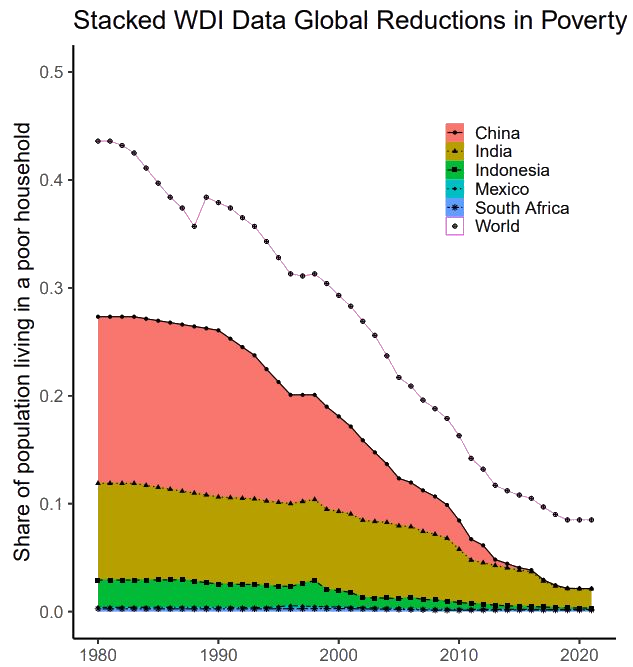
The share of the global population living in extreme poverty fell dramatically from an estimated 36% in 1990 to 9% in 2015. We describe how this decline happened: the extent to which changes within as opposed to between cohorts contributed to poverty declines, and the key changes in the lives of households as they transitioned out of (and into) poverty. We do so using cross-sectional and panel sources that are representative or near-representative of five countries that collectively accounted for 75% of global poverty decline between 1990 and 2015. The data show that overlapping birth cohorts experienced the decline of poverty together over time, such that poverty decline can be viewed as a primarily within-cohort phenomenon. Within cohorts, the data reveal substantial churn, casting the challenge of escaping poverty as a “slippery slope” more than a long-term trap. The data also illustrate a diversity of pathways out of poverty: sectoral transitions, migration, and changing occupational choices and female labor force participation can all account for some part of poverty reduction, but in all but a handful of cases, a majority of households exiting poverty did so without experiencing these changes.
Media coverage
Piece featured in The Economist, “India has undermined a popular myth about development”, February 27th, 2025.
Piece covered by
VoxDev on VoxDevTalks, “How has global poverty fallen”.
YouTube video featuring Tom Vogl
available here.
Publicly available presentations
Presented at NBER Development Economics, Fall 2024 conference by Tom Vogl. \